Back
Speed Challenge
An interactive sports installation that transforms running into a playful competitive experience through real-time timing, physical interaction, and tangible rewards.
Period
Feb 2026 - May 2026
Technologies
C++
Python
Socket.IO
Raspberry Pi
ESP32
Laser Cutting
3D Printing
Thermal Printer

Overview
Speed Challenge is an interactive prototype installation developed around the concept of movement, competition, and public interaction. The experience invites participants to sprint between two physical pillars positioned several meters apart while their running time is measured in real time.
The project was designed as an experiential interaction prototype where physical movement becomes the primary interface. Instead of relying on touchscreens or complex instructions, the installation encourages spontaneous participation through visible interaction, competitive tension, and direct feedback.
Participants begin by pressing an illuminated start button before racing toward the finish pillar. Once the finish button is pressed, the system immediately displays the recorded time, compares the result against the current high score, and prints a personalized ticket containing the achieved score and an athletic fact.
Experience Loop
A major focus during development was designing a strong and intuitive experience loop that could function without explanation. The installation had to naturally attract passersby and guide them through the interaction from curiosity to reward.
The experience starts with the attract phase. The two illuminated pillars, visible timer, and competitive high-score system immediately communicate activity and challenge. Seeing other participants sprint between the pillars creates social curiosity and encourages additional users to join.
The entry phase begins when users notice the illuminated start button. The lighting subtly communicates where interaction is expected, lowering the barrier to participation without requiring written instructions.
During the engage phase, participants physically run from one pillar to the other while attempting to beat the fastest recorded time. The pressure of the high score and the visible feedback system create tension and excitement, motivating repeated attempts and group interaction.
The exit phase delivers immediate gratification. Users instantly receive their running time through the display and audio feedback, reinforcing the feeling of accomplishment.
Finally, the extend phase transforms the interaction into a lasting memory. Each participant receives a printed thermal ticket containing their result and an athletics-related fact, creating a tangible souvenir that can be shared with friends or kept as a reminder of the experience.
Prototype Development
The project required multiple prototype and testing iterations before reaching a reliable final installation. Early development focused on validating whether the interaction itself felt intuitive and engaging enough in a public environment.
We experimented with different physical constructions for the pillars using laser-cut components and gradually refined the mounting systems for the internal hardware. During testing, several structural and technical problems emerged that required iterative improvements.
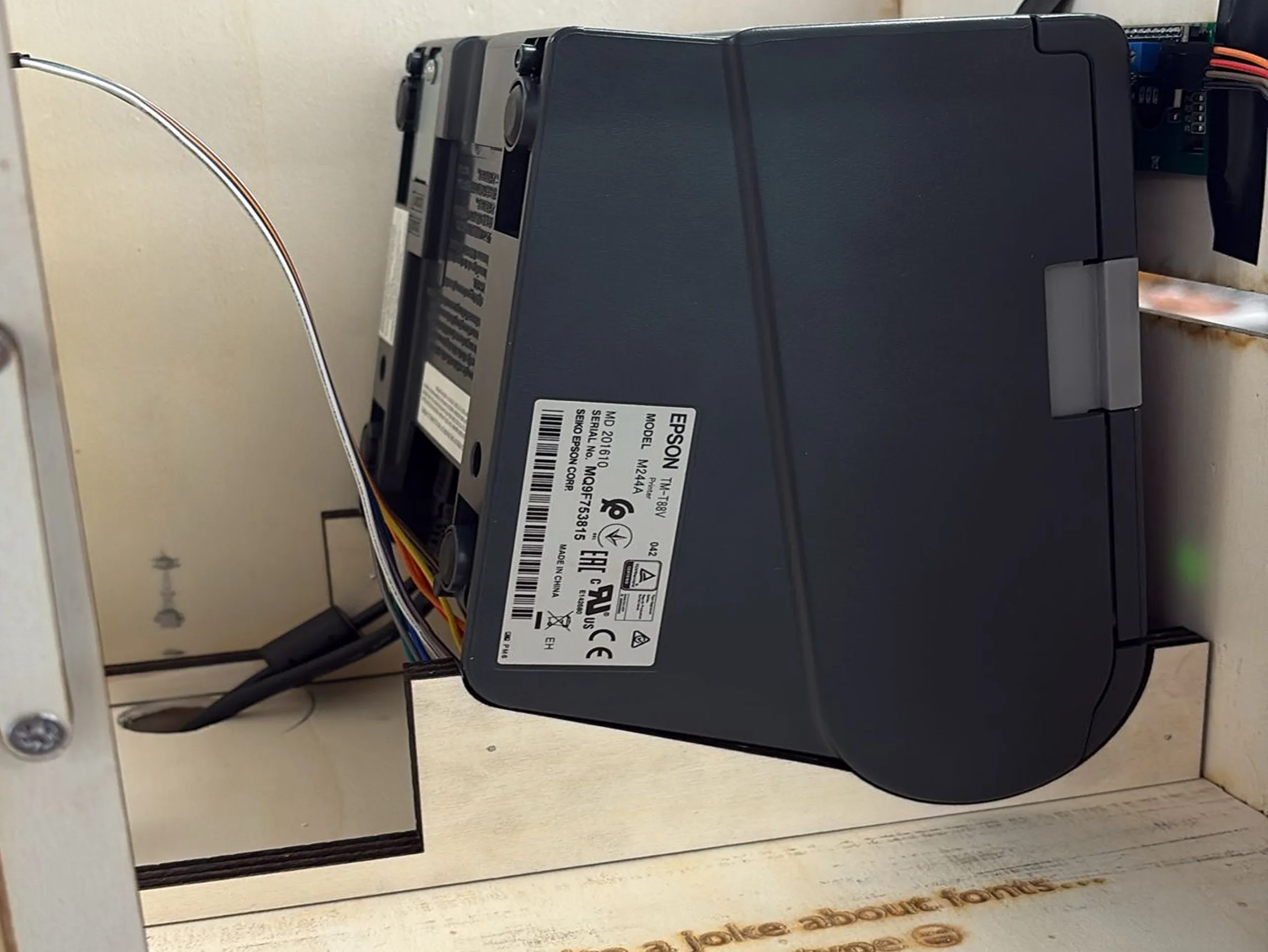
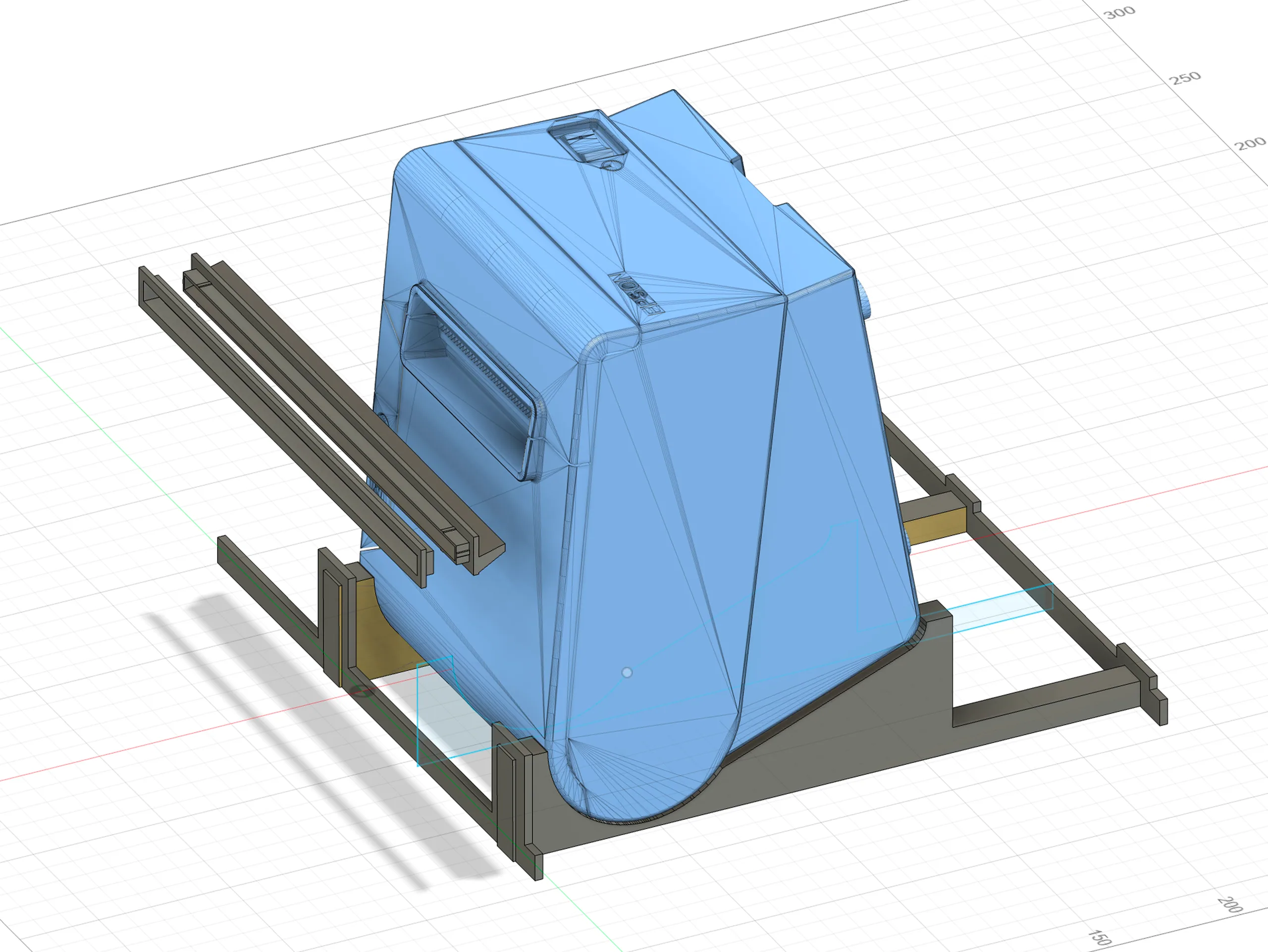
One challenge involved stabilizing the thermal printer inside the pillar housing. Initial mounting solutions caused the printer to shift during operation, which affected ticket output reliability. Additional support structures and custom-designed components were introduced to properly secure the printer.
Another important iteration focused on the ticket exit mechanism. Early prototypes caused printed tickets to become stuck inside the pillar. This issue was solved through the design of a custom 3D-printed guide that improved the ticket flow and created a smoother user experience.
The interaction itself also evolved throughout testing. Feedback from users showed that some participants were unsure when the timer had successfully started or stopped. To solve this, LED-lit buttons and audio confirmation through a piezo speaker were added, making the interaction more understandable and responsive.
Hardware & Technical Architecture
At the center of the installation, a Raspberry Pi 5 functioned as the main controller, coordinating timing, audio feedback, ticket printing, display output, and communication between all connected devices.
Each pillar was equipped with an ESP32-C3 microcontroller responsible for handling interaction events and maintaining the Socket.IO connection with the central system. During development, the original networking setup running directly from the Raspberry Pi proved unreliable for continuous real-time communication. To improve stability, the ESP32-C3 devices were introduced together with a custom keep-alive mechanism that periodically sent requests to maintain an active websocket connection.
The installation included multiple hardware components working together simultaneously:
- Illuminated physical push buttons for starting and stopping runs
- An LCD display showing the current high score
- A piezo speaker providing direct audio confirmation
- Custom laser-cut pillar enclosures
- 3D-printed mounting and guidance components
- Internal wiring and power distribution systems
A key part of the experience loop was the extend phase, where participants received a physical ticket after completing their run. For this, an Epson TM-T88V thermal receipt printer was integrated into the finish pillar. The printer generated personalized tickets containing the participant’s running time together with an athletics-related fact, transforming the interaction into a tangible memory users could keep or share afterwards.
Considerable effort went into synchronizing all hardware components in real time. Timing accuracy, responsive button interaction, stable websocket communication, reliable ticket printing, and immediate feedback were all essential to maintaining a smooth and uninterrupted user experience.
Testing & Results
User testing played an important role throughout the project. Multiple prototype sessions were organized where participants interacted with the installation without receiving extensive explanations beforehand.
The tests revealed that most users immediately understood the core interaction of running between the pillars. The competitive aspect proved highly effective in motivating repeated participation, especially when users challenged friends to beat existing scores.
The printed ticket was consistently perceived as a valuable addition to the experience because it extended the interaction beyond the installation itself. At the same time, testing also exposed several reliability issues related to printing and synchronization, which became important focus points during later development iterations.
The final result is a fully functional interactive prototype that demonstrates how technology, movement, and experience come together in a public installation. Speed Challenge transforms a simple sprint between two pillars into a playful and social experience featuring competition, immediate feedback, and a physical ticket for extra motivation and engagement. Thanks to numerous test and prototype iterations, the project has been developed into an interactive installation that is both technically reliable and intuitive to use.